"Why one more?" asks Guy Prentiss Waters in the Preface to his A Study Commentary on the Acts of Apostles, noting the proliferation of publications on this book of the Bible. "What will this commentary contribute to the burgeoning literature?" As Waters explains, he intends his commentary to be 1) brief and clear, 2) geared towards the exposition of the text, and 3) distinctively Reformed in orientation. Waters is successful in each of these three areas, providing a commentary that is both readable and useful for serious students of the Bible.
Waters' commentary is published by EP Books as part of the EP Study Commentary series, which is intended for a general audience and written from a Reformed perspective. Due to its length, Acts has tended to produce commentaries of ever-increasing length (consider Craig Keener's soon-to-be-completed four volume monster), but Waters' volume clocks in at just over 600 pages of reasonably-sized type. In his Introduction, Waters briefly surveys the standard questions of authorship, date, title, genre and purpose, arguing that Luke has written Acts to edify Christians by highlighting "the continued word and deeds of the exalted Jesus through his apostles." He then divides the text into 18 major sections, with further subdivisions under each. After providing his own English translation of the text, Waters walks verse-by-verse through the pertinent exegetical details and interacts with the secondary literature. The volume is well-researched, with copious footnotes provided for further study, yet Waters never lets the main commentary get bogged down with extraneous details or arcane technical discussions. For example, Waters often highlights significant details from the Greek text, but in such a way that readers need not be students of Greek to grasp Waters' arguments. In addition to examining Acts itself, Waters also focuses on connections with other Scriptures, such as the use of the Old Testament in Acts and its links with the Gospel of Luke.
Another key feature of Waters' commentary is that the exegetical analysis of each subdivision of the text is followed by several paragraphs of Application. In these sections, Waters demonstrates how the Scriptural texts inform the lives of Christians today. These sections are very much pastoral in nature, and address many of the practical questions that naturally arise from reading Acts, such as the nature of the continued role of the Holy Spirit in the lives of believers, the fact of conflict inside the church, and the reality of opposition to the Gospel from outside, just to name a few. In these sections Waters often makes use of Calvin or the Westminster Standards to integrate the text with a broader Reformed perspective.
All in all, Waters does an admirable job of providing a detailed yet readable commentary on Acts. The depth of engagement makes the book ideal for use in preparing sermons or Bible study lessons, yet anyone interested in growing in their faith through studying the Acts of the Apostles would benefit from this commentary.
(Disclaimer: I received a copy of the book in exchange for providing a review, with no obligations as to its content.)
Showing posts with label review. Show all posts
Showing posts with label review. Show all posts
Tuesday, April 07, 2015

Friday, January 02, 2015
Books Read in 2014 (Gaines)
- Summer Lightning (Wodehouse)
- The Silmarillion (Tolkien)
- Ender's Game (Card)
- Bonhoeffer: Pastor, Martyr, Prophet, Spy (Metaxas)
- Speaker for the Dead (Card)
- Desiring the Kingdom: Worship, Worldview, and Cultural Formation (Cultural Liturgies Vol.1) (Smith)
- William Shakespeare's Star Wars (Doescher)
- Unfinished Tales of Numenor and Middle-earth (Tolkien)
- The Children of Húrin (Tolkien)
- 100 Cupboards (Wilson)
- Blackwater: The Rise of the World's Most Powerful Mercenary Army (Scahill)
- Worshipping With Calvin: Recovering the Historic Ministry and Worship of Reformed Protestantism (Johnson) -- REVIEW
- Xenocide (Card)
- World War Z: An Oral History of the Zombie War (Brooks)
- Children of the Mind (Card)
- 1 Samuel For You (Chester) -- REVIEW
- Imagining the Kingdom: How Worship Works (Cultural Liturgies Vol.2) (Smith)
- Dandelion Fire: Book 2 of 100 Cupboards (Wilson)
- Songs of a Suffering King: The Grand Christ Hymn of Psalms 1–8 (Fesko) -- REVIEW
- The Chestnut King: Book 3 of 100 Cupboards (Wilson)
- Infinite Jest (Wallace)
- The Baptized Body (Leithart)
- Joy in the Morning (Wodehouse)
Sunday, October 19, 2014
Book Review: Jonathan Edwards (Christian Biographies for Young Readers)
A few years ago, from 2005-2007, we spent our Fourth of July weekends in Annapolis, Maryland, at something called the JEI conference. Lots of speakers, books, good food, strolling around the lovely historic city, and fireworks. It was sponsored by the Jonathan Edwards Institute, which existed to promote Edwards' ideas for a modern audience and "foster a God-entranced worldview.". And we loved it (because we're nerds like that).
Fast-forward almost ten years later and though the JEI Institute no longer exists, we are finding opportunities to share some of these same passions with our kids. One way is through a great series of biographies from Simonetta Carr. This particular biography came to us most timely, as we are actually studying American History this year and have been reading quite a few accounts of early colonists.

Carr's latest contribution to her Christian Biographies for Young Readers series, Jonathan Edwards, exceeds my expectations. Though I thought I knew much about Edwards' writings, I realized by reading this book how few details I really knew about his life. All of the books in this series are of excellent quality, hardback and sturdy and with exceptional content, but this one especially has some fascinating facts, photographs and illustrations. In this biography, Carr shares details of his life (1703-1758) from his time as an inquisitive youth to his death at a relatively young age due to illness, when he was then president of Princeton.
If all you know of Edwards is the classic sermon "Sinners in the Hands of an Angry God," you will be most surprised and encouraged by reading about his whole life's work. His delight in Creation and wonder at the glory of God are evident throughout his story. Even as a child he was interested in science, and observed creatures like the infamous spider and marveled at their unique qualities. There's even an original sketch by Edwards included in the book. His time at Yale brought him into contact with contemporary philosophers and thinkers like Isaac Netwon and Voltaire. As he struggled and wrestled with these new ideas, he always checked them against the Truth he found in Scripture. And so he became captivated by the excellency and wisdom of his Creator. So much so, that Carr writes: "Often, Edwards felt so impressed by God's glory and beauty that he started to sing." What a fantastic picture of a man whose heart chased after God!
There is a good amount of information about his life's work as a preacher, of course, including the first Great Awakening. But Carr also examines his struggles as his beliefs conflicted with his congregation. There is an excellent chapter on his friendship with David Brainerd, missionary to the Native Americans, which later inspired him to move his own family to Stockbridge and become a missionary himself. His interactions with the Indians and his desire for their well-being, fair treatment, and the education of their children in a school alongside his own is much to be praised, and is quite unlike many of the other accounts we have been reading in our American History studies this year.
I highly recommend this biography to anyone interested in learning more about Edward's life. Carr includes a helpful map, timeline, and an appendix with facts about the time period as well as a letter from Edwards to one of his children. As always, the illustrations are rich and well-done, perfectly suited to the text. Reading this has provided our family with an excellent model of what it means to live one's life out faithfully, to "discover God as He has revealed Himself in the Scriptures" and not try to "match the Bible to our own ideas." Many of the chapters offer frameworks for understanding the cultural context in which Edwards lived and offer up ideas for discussion, growth and further reading. This is a wonderful addition to any family library.
If you are interested in any of Jonathan Edwards' writings, I would recommend the Edwards Center at Yale University, which offers a large collection online.
(Disclaimer: I received a copy of the book from Cross Focused Reviews in exchange for providing this review, with no obligations as to the content of the review.)
Fast-forward almost ten years later and though the JEI Institute no longer exists, we are finding opportunities to share some of these same passions with our kids. One way is through a great series of biographies from Simonetta Carr. This particular biography came to us most timely, as we are actually studying American History this year and have been reading quite a few accounts of early colonists.
Carr's latest contribution to her Christian Biographies for Young Readers series, Jonathan Edwards, exceeds my expectations. Though I thought I knew much about Edwards' writings, I realized by reading this book how few details I really knew about his life. All of the books in this series are of excellent quality, hardback and sturdy and with exceptional content, but this one especially has some fascinating facts, photographs and illustrations. In this biography, Carr shares details of his life (1703-1758) from his time as an inquisitive youth to his death at a relatively young age due to illness, when he was then president of Princeton.
If all you know of Edwards is the classic sermon "Sinners in the Hands of an Angry God," you will be most surprised and encouraged by reading about his whole life's work. His delight in Creation and wonder at the glory of God are evident throughout his story. Even as a child he was interested in science, and observed creatures like the infamous spider and marveled at their unique qualities. There's even an original sketch by Edwards included in the book. His time at Yale brought him into contact with contemporary philosophers and thinkers like Isaac Netwon and Voltaire. As he struggled and wrestled with these new ideas, he always checked them against the Truth he found in Scripture. And so he became captivated by the excellency and wisdom of his Creator. So much so, that Carr writes: "Often, Edwards felt so impressed by God's glory and beauty that he started to sing." What a fantastic picture of a man whose heart chased after God!
There is a good amount of information about his life's work as a preacher, of course, including the first Great Awakening. But Carr also examines his struggles as his beliefs conflicted with his congregation. There is an excellent chapter on his friendship with David Brainerd, missionary to the Native Americans, which later inspired him to move his own family to Stockbridge and become a missionary himself. His interactions with the Indians and his desire for their well-being, fair treatment, and the education of their children in a school alongside his own is much to be praised, and is quite unlike many of the other accounts we have been reading in our American History studies this year.
I highly recommend this biography to anyone interested in learning more about Edward's life. Carr includes a helpful map, timeline, and an appendix with facts about the time period as well as a letter from Edwards to one of his children. As always, the illustrations are rich and well-done, perfectly suited to the text. Reading this has provided our family with an excellent model of what it means to live one's life out faithfully, to "discover God as He has revealed Himself in the Scriptures" and not try to "match the Bible to our own ideas." Many of the chapters offer frameworks for understanding the cultural context in which Edwards lived and offer up ideas for discussion, growth and further reading. This is a wonderful addition to any family library.
If you are interested in any of Jonathan Edwards' writings, I would recommend the Edwards Center at Yale University, which offers a large collection online.
(Disclaimer: I received a copy of the book from Cross Focused Reviews in exchange for providing this review, with no obligations as to the content of the review.)
Friday, October 17, 2014
Book Review -- Songs of a Suffering King: The Grand Christ Hymn of Psalms 1–8
"The book of Psalms ... is the biggest book in the Bible, but for many in the church its contents are largely mysterious and out of sight," laments J. V. Fesko in the Introduction to his latest book, Songs of a Suffering King: The Grand Christ Hymn of Psalms 1-8. To remedy this deficiency, Fesko aims to convince his readers of two important characteristics of the Psalter: 1) that it is focused on the person and work of Christ -- not just in certain "christological psalms" but in its entirety; and 2) that it is not a randomly-arranged collection of poetry but, rather, is a deliberately-organized work with an overarching story. By focusing on the first 8 Psalms, Fesko is able to demonstrate both these characteristics in the text as well as lay out an approach for studying the entire Psalter.
Fesko's book is explicitly "a devotional exploration of the first eight Psalms" and is intended for the edification of Christian readers. Each chapter focuses on a different Psalm, tracing its significance from its original context to its fulfillment in Christ to its continued application for Christians. Each chapter includes a list of questions for further reflection and study. And, since the Psalms were intended to be sung, the book includes metrical versions of each of the studied psalms, as well as resources for obtaining sheet music and audio versions of the tunes.
Overall, Fesko does an admirable job of demonstrating the aforementioned important characteristics of the Psalter from his chosen texts and from the Scripture as a whole. The notion that certain Psalms are Christ-focused is readily established by looking at how the New Testament authors connect the Psalms to Jesus, such as the citation of Psalm 2 in Acts 4. But Fesko's argument is not just that certain Psalm texts point to Christ, but that in fact, the entire Psalter does. He notes Jesus' own words in Luke 24, that "Everything must be fulfilled that is written about me in the Law of Moses, the Prophets and the Psalms," indicating that the Old Testament Scriptures anticipate the coming of the Christ in their entirety, not just in isolated proof-texts or prophecies. In his exploration of Psalms 1-8, Fesko then identifies specific connections between the texts and the person and work of Christ, frequently demonstrating how the life of David serves as a type that was ultimately fulfilled in Jesus. Thus, the righteous man of Psalm 1 is best understood to be the truly Righteous One, the true Anointed One of Psalm 2. However, just as Psalms 3-7 express the hardships and afflictions that God's chosen king David endured at the hands of the wicked, these Psalms also point forward to the undeserved suffering of David's greater son. Yet despite these tribulations, Psalm 8 offers words of praise and worship to God, specifically for the blessings given to man, best interpreted as the majesty bestowed on the Son of Man.
Another strength of Fesko's book is how he draws personal applications out of the Psalms and their focus on Christ. For example, Psalm 1 paints a vivid contrast between the prosperity of the righteous man and the ultimate destruction of the wicked. Yet the application is not simply that people will prosper so long as they act righteously (as if that were possible); rather, Jesus alone is the truly Righteous One, and those who seek refuge in him will be nurtured by him and bear fruit like a tree planted by the streams. Similarly, Fesko sees cries for deliverance from enemies, such as those in Psalm 3, as pointing to the deliverance found only in Christ, a deliverance not only from the wrath to come but also into eternal rest. I especially appreciated Fesko's appeal that the church not neglect the portions of the Psalms that address suffering and lament. The Psalms express the full range of human experience and emotion, and we deprive ourselves of rich resources if we limit our focus to Psalms of rejoicing and gladness.
If I had any real quibbles with the book, they'd be with some of Fesko's presumptions that the Psalter's human authors clearly understood their writings to be christological. Admittedly, the sharply debated issue of Old Testament fulfillment in the New is too large to tackle in such a short book. But it strikes me that Fesko assumes more than is warranted. A couple of examples: first, in discussing Psalm 4, Fesko begins by examining the original context, particularly the applicable details from David's life, but then jumps from David's crying out to the "God of my righteousness" (4:1) all the way to asserting that "David knows that the Lord is his righteousness—the Lord has graciously forgiven him of his sins and imputed the righteousness, or obedience, of the coming Messiah to him." Secondly, concerning Psalm 8, Fesko states that "David does not merely have the creation of man in view here, however praiseworthy it is. Rather, he ultimately offers a hymn of praise for the true Son of Man, Jesus Christ." In both cases, Fesko makes theologically accurate statements, but given the progressive nature of Biblical revelation, I'm unsure whether an Old Testament author like David might have grasped the full meaning of his own writings. It seems just as likely that the inspired authors revealed far more than they understood at the time, with subsequent revelation bringing greater clarity (e.g., as Hebrews 2 does for Psalm 8). That said, the issue of David's understanding doesn't detract from the book in a major way, and as Fesko repeatedly demonstrates, the New Testament provides interpretive clarity to many of the passages he discusses.
Overall, I would recommend Songs of a Suffering King: The Grand Christ Hymn of Psalms 1-8 to anyone interested in learning more about the Psalms. J.V. Fesko has done a great service by demonstrating the connections between the Psalter and the person and work of Jesus Christ, doing so in a way that not only does justice to the text but also draws out applications for Christian living and discipleship. My hope is that readers of the book would be inspired to take advantage of the great treasures that God's people have been given in the Psalter.
(Disclaimer: I received a copy of the book in exchange for providing a review, with no obligations as to the content of the review.)
Fesko's book is explicitly "a devotional exploration of the first eight Psalms" and is intended for the edification of Christian readers. Each chapter focuses on a different Psalm, tracing its significance from its original context to its fulfillment in Christ to its continued application for Christians. Each chapter includes a list of questions for further reflection and study. And, since the Psalms were intended to be sung, the book includes metrical versions of each of the studied psalms, as well as resources for obtaining sheet music and audio versions of the tunes.
Overall, Fesko does an admirable job of demonstrating the aforementioned important characteristics of the Psalter from his chosen texts and from the Scripture as a whole. The notion that certain Psalms are Christ-focused is readily established by looking at how the New Testament authors connect the Psalms to Jesus, such as the citation of Psalm 2 in Acts 4. But Fesko's argument is not just that certain Psalm texts point to Christ, but that in fact, the entire Psalter does. He notes Jesus' own words in Luke 24, that "Everything must be fulfilled that is written about me in the Law of Moses, the Prophets and the Psalms," indicating that the Old Testament Scriptures anticipate the coming of the Christ in their entirety, not just in isolated proof-texts or prophecies. In his exploration of Psalms 1-8, Fesko then identifies specific connections between the texts and the person and work of Christ, frequently demonstrating how the life of David serves as a type that was ultimately fulfilled in Jesus. Thus, the righteous man of Psalm 1 is best understood to be the truly Righteous One, the true Anointed One of Psalm 2. However, just as Psalms 3-7 express the hardships and afflictions that God's chosen king David endured at the hands of the wicked, these Psalms also point forward to the undeserved suffering of David's greater son. Yet despite these tribulations, Psalm 8 offers words of praise and worship to God, specifically for the blessings given to man, best interpreted as the majesty bestowed on the Son of Man.
Another strength of Fesko's book is how he draws personal applications out of the Psalms and their focus on Christ. For example, Psalm 1 paints a vivid contrast between the prosperity of the righteous man and the ultimate destruction of the wicked. Yet the application is not simply that people will prosper so long as they act righteously (as if that were possible); rather, Jesus alone is the truly Righteous One, and those who seek refuge in him will be nurtured by him and bear fruit like a tree planted by the streams. Similarly, Fesko sees cries for deliverance from enemies, such as those in Psalm 3, as pointing to the deliverance found only in Christ, a deliverance not only from the wrath to come but also into eternal rest. I especially appreciated Fesko's appeal that the church not neglect the portions of the Psalms that address suffering and lament. The Psalms express the full range of human experience and emotion, and we deprive ourselves of rich resources if we limit our focus to Psalms of rejoicing and gladness.
If I had any real quibbles with the book, they'd be with some of Fesko's presumptions that the Psalter's human authors clearly understood their writings to be christological. Admittedly, the sharply debated issue of Old Testament fulfillment in the New is too large to tackle in such a short book. But it strikes me that Fesko assumes more than is warranted. A couple of examples: first, in discussing Psalm 4, Fesko begins by examining the original context, particularly the applicable details from David's life, but then jumps from David's crying out to the "God of my righteousness" (4:1) all the way to asserting that "David knows that the Lord is his righteousness—the Lord has graciously forgiven him of his sins and imputed the righteousness, or obedience, of the coming Messiah to him." Secondly, concerning Psalm 8, Fesko states that "David does not merely have the creation of man in view here, however praiseworthy it is. Rather, he ultimately offers a hymn of praise for the true Son of Man, Jesus Christ." In both cases, Fesko makes theologically accurate statements, but given the progressive nature of Biblical revelation, I'm unsure whether an Old Testament author like David might have grasped the full meaning of his own writings. It seems just as likely that the inspired authors revealed far more than they understood at the time, with subsequent revelation bringing greater clarity (e.g., as Hebrews 2 does for Psalm 8). That said, the issue of David's understanding doesn't detract from the book in a major way, and as Fesko repeatedly demonstrates, the New Testament provides interpretive clarity to many of the passages he discusses.
Overall, I would recommend Songs of a Suffering King: The Grand Christ Hymn of Psalms 1-8 to anyone interested in learning more about the Psalms. J.V. Fesko has done a great service by demonstrating the connections between the Psalter and the person and work of Jesus Christ, doing so in a way that not only does justice to the text but also draws out applications for Christian living and discipleship. My hope is that readers of the book would be inspired to take advantage of the great treasures that God's people have been given in the Psalter.
(Disclaimer: I received a copy of the book in exchange for providing a review, with no obligations as to the content of the review.)
Monday, September 01, 2014
Book Review -- 1 Samuel for You
1 Samuel For You by Tim Chester is the fifth installment in the God's Word for You series published by The Good Book Company. As noted in the Preface, the series is intended to provide expository Biblical studies for a broad audience in a manner
that is "Bible centered, Christ glorifying, relevantly applied, and
easily readable." Each volume is written with three different
purposes/audiences in mind: "Read," as a guide to the contents of the
Biblical book; "Feed," as a daily devotional, and "Lead," as a resource for
preaching and teaching through the Biblical text. The series isn't intended to provide scholarly commentary, and the reader is not expected to have understanding of
the Biblical languages or even a high level of Scriptural knowledge. 1 Samuel For You begins with a brief introduction to the book's themes and historical/canonical background, and each subsequent chapter focuses on a 1-2 chapter block of the Biblical text. In addition to examining the details of the specific text, Chester highlights points of connection with other sections of Scripture (both Old and New Testament) and applications for the Christian reader. Each chapter contains questions for further reflection, and the book contains a glossary and Appendices.
In my review of the series' initial volume (Galatians For You), I noted that author Timothy Keller had set an extremely high bar for the series and that I even pitied authors of subsequent installments. But 1 Samuel For You is every bit as good, and Tim Chester does a magnificent job working within the Read/Feed/Lead format of the series. By far the book's biggest strength is Chester's command of the Biblical text itself. Although the series is intended for a broader audience, Chester does a tremendous job of analyzing the text: not only does he focus on technical details such as uses of chiastic structure or plays on words in the original Hebrew, but he also communicates their significance so as to remain accessible to the layperson. Furthermore, he connects the details in individual verses to the larger context of 1 Samuel. For example, in his opening chapter, Chester argues that the account of Hannah in in 1 Samuel 1-2 is not a mere example of faith in the midst of adversity (as some treat it); instead, this account, especially through Hannah's prayer, introduces the theme of reversals that runs throughout the book, whereby God "humbles and exalts" (2:7), lifting up the poor and needy while silencing the wicked (2:8-9). Throughout the narrative, Chester demonstrates recurrences of this theme, culminating in the tragic fall of the asked-for king Saul and the unexpected ascent of the shepherd boy David to the throne.
Chester also excels in connecting 1 Samuel to the larger canon of Scripture. For example, he demonstrates how the early chapters of the book present a continuation of the cycle established in the book of Judges, whereby Israel's sin leads to God's judgment, and their repentance results in God sending a deliverer - in this case, Samuel. Furthermore, the repeated refrain in Judges that the people were in disarray because "in those days Israel had no king" at first seems headed towards a positive resolution with Saul, whose ascent to the throne is described with several allusions back to Judges. Yet Saul, despite his kingly station, proves every bit as fallible as previous judges of Israel. More importantly, Chester highlights how the failure of Saul sets the stage for the rise of David to the throne. 1 Samuel, as he notes, is not really about the transition of Israel from the reign of Saul to that of David; rather, it is about the shift from no monarchy to monarchy. Moses had anticipated that Israel would one day have a king (see Deuteronomy 17) -- the question is whether they would choose a king like those of the nations or one of God's choosing. 1 Samuel portrays two different options for how Moses' words could find fulfillment.
Chester not only demonstrates connections between 1 Samuel and the Old Testament, but more importantly, he also shows how David prefigures the coming of Jesus. Not that David is a mere cipher -- on the contrary, 1 Samuel presents him in exemplary terms. Despite his humble origins, he is chosen by God to be king (keeping with the theme of reversals throughout the book). He is repeatedly tested, particularly with the temptation to seize by force the throne that God had already promised to him. Yet David refuses to harm the Lord's anointed and spares Saul's life on more than one occasion. Instead of claiming what is rightfully his, David endures many years of betrayal and suffering before he comes to the throne. Chester masterfully connects these details of David's life with that of Jesus, who surrendered his divine rights and willingly lived "on the margins" and faced rejection and betrayal for the sake of a higher calling. These frequent connections between David's life and the typological fulfillment in Jesus Christ permeate Chester's book; furthermore, Chester draws practical applications for Christian readers of 1 Samuel by demonstrating how this pattern of enduring suffering on the way to glory still holds for followers of Jesus.
Overall, I thoroughly enjoyed 1 Samuel For You, and I think any Christian reader would be edified by it. Tim Chester does a wonderful job of connecting the book of 1 Samuel to the larger Biblical drama of redemption in a straightforward and engaging manner, doing a particularly good job of demonstrating how the book points to the ultimate fulfillment of God's purposes in Jesus Christ. My only real criticism is the same one I made about Keller's Galatians For You, concerning the Read/Feed/Lead format of the series: I'm still not sure the book succeeds as a one-stop shop for preaching and teaching through the book. I would certainly use it as a resource, but in conjunction with others. That said, Chester offers many keen insights on 1 Samuel concerning both the details of the text and applications for Christian readers, such that teachers and preachers would do well to consult it in their preparations. I guess my only other complaint is that it only covers 1 Samuel -- as Chester notes in the introduction, 1 and 2 Samuel were originally a single volume. I truly hope that Dr. Chester has a 2 Samuel For You in the works!
(Disclaimer: I received a free copy of the book in exchange for writing a review, though without any stipulations on its content.)
In my review of the series' initial volume (Galatians For You), I noted that author Timothy Keller had set an extremely high bar for the series and that I even pitied authors of subsequent installments. But 1 Samuel For You is every bit as good, and Tim Chester does a magnificent job working within the Read/Feed/Lead format of the series. By far the book's biggest strength is Chester's command of the Biblical text itself. Although the series is intended for a broader audience, Chester does a tremendous job of analyzing the text: not only does he focus on technical details such as uses of chiastic structure or plays on words in the original Hebrew, but he also communicates their significance so as to remain accessible to the layperson. Furthermore, he connects the details in individual verses to the larger context of 1 Samuel. For example, in his opening chapter, Chester argues that the account of Hannah in in 1 Samuel 1-2 is not a mere example of faith in the midst of adversity (as some treat it); instead, this account, especially through Hannah's prayer, introduces the theme of reversals that runs throughout the book, whereby God "humbles and exalts" (2:7), lifting up the poor and needy while silencing the wicked (2:8-9). Throughout the narrative, Chester demonstrates recurrences of this theme, culminating in the tragic fall of the asked-for king Saul and the unexpected ascent of the shepherd boy David to the throne.
Chester also excels in connecting 1 Samuel to the larger canon of Scripture. For example, he demonstrates how the early chapters of the book present a continuation of the cycle established in the book of Judges, whereby Israel's sin leads to God's judgment, and their repentance results in God sending a deliverer - in this case, Samuel. Furthermore, the repeated refrain in Judges that the people were in disarray because "in those days Israel had no king" at first seems headed towards a positive resolution with Saul, whose ascent to the throne is described with several allusions back to Judges. Yet Saul, despite his kingly station, proves every bit as fallible as previous judges of Israel. More importantly, Chester highlights how the failure of Saul sets the stage for the rise of David to the throne. 1 Samuel, as he notes, is not really about the transition of Israel from the reign of Saul to that of David; rather, it is about the shift from no monarchy to monarchy. Moses had anticipated that Israel would one day have a king (see Deuteronomy 17) -- the question is whether they would choose a king like those of the nations or one of God's choosing. 1 Samuel portrays two different options for how Moses' words could find fulfillment.
Chester not only demonstrates connections between 1 Samuel and the Old Testament, but more importantly, he also shows how David prefigures the coming of Jesus. Not that David is a mere cipher -- on the contrary, 1 Samuel presents him in exemplary terms. Despite his humble origins, he is chosen by God to be king (keeping with the theme of reversals throughout the book). He is repeatedly tested, particularly with the temptation to seize by force the throne that God had already promised to him. Yet David refuses to harm the Lord's anointed and spares Saul's life on more than one occasion. Instead of claiming what is rightfully his, David endures many years of betrayal and suffering before he comes to the throne. Chester masterfully connects these details of David's life with that of Jesus, who surrendered his divine rights and willingly lived "on the margins" and faced rejection and betrayal for the sake of a higher calling. These frequent connections between David's life and the typological fulfillment in Jesus Christ permeate Chester's book; furthermore, Chester draws practical applications for Christian readers of 1 Samuel by demonstrating how this pattern of enduring suffering on the way to glory still holds for followers of Jesus.
Overall, I thoroughly enjoyed 1 Samuel For You, and I think any Christian reader would be edified by it. Tim Chester does a wonderful job of connecting the book of 1 Samuel to the larger Biblical drama of redemption in a straightforward and engaging manner, doing a particularly good job of demonstrating how the book points to the ultimate fulfillment of God's purposes in Jesus Christ. My only real criticism is the same one I made about Keller's Galatians For You, concerning the Read/Feed/Lead format of the series: I'm still not sure the book succeeds as a one-stop shop for preaching and teaching through the book. I would certainly use it as a resource, but in conjunction with others. That said, Chester offers many keen insights on 1 Samuel concerning both the details of the text and applications for Christian readers, such that teachers and preachers would do well to consult it in their preparations. I guess my only other complaint is that it only covers 1 Samuel -- as Chester notes in the introduction, 1 and 2 Samuel were originally a single volume. I truly hope that Dr. Chester has a 2 Samuel For You in the works!
(Disclaimer: I received a free copy of the book in exchange for writing a review, though without any stipulations on its content.)
Monday, June 23, 2014
Book Review -- Worshipping With Calvin: Recovering the Historic Ministry and Worship of Reformed Protestantism
“Our sense of urgency is profound as we survey the ecclesiastical landscape,” states Terry L. Johnson in the opening chapter of Worshipping With Calvin, as he recounts the rapid decline of American Evangelical Christians’ fidelity to historic Christian beliefs, morals and piety. Invoking the maxim lex orandi, lex credenda, lex vivendi (“The law of prayer is the law of faith is the law of life”), Johnson asserts that public worship is too often overlooked as a major factor influencing whether or not Christians remain committed to their faith. Furthermore, he argues that many recent innovations to public worship have directly contributed to the overall decline of American Evangelicalism. Johnson’s appeal is for Christians, especially those among the neo-Calvinists of the “young, restless, reformed” movement to “recover the historic ministry and worship of Reformed Protestantism,” in hopes that it would prove just as beneficial to their Christian faith and practice as it has for generations of Christians who have gone before.
After the introductory chapter, Johnson lays out a two-pronged case advocating Reformed Worship and Ministry. The first line of argumentation is along exegetical and historical grounds. Drawing significantly from the work of Hughes Oliphant Old (to whom the book is dedicated), Johnson demonstrates the many ways in which the Reformers sought to base their liturgical reforms primarily on the Scriptures, and then secondarily on the practices of the early church. Instead of manmade traditions, they attempted to pattern the elements of Christian worship after the ways described Bible itself, such as lectio continua reading of the Scriptures, manifold types of prayers, singing of psalms and hymns, and the understanding of the sacraments as visible, covenantal signs. Next, Johnson makes the case for Reformed worship along theological grounds, demonstrating how the Reformers applied the 5 Sola mottoes of the Reformation – sola scriptura, solus Christus, sola fide, sola gratia, and soli Deo Gloria – directly to their liturgical reforms. For example, the principle of sola scriptura gave rise to the Reformed regulative principle of worship, which limits worship practices to only those specified in the Bible. As Johnson argues, both the theological applications of the Reformers and their exegetical/historical research converge to make a persuasive case for the liturgical reforms enacted by the Protestant Reformers.
In the next section of the book, Johnson lays out the following five strengths of Reformed Worship (and compares them with corresponding weaknesses in other approaches to worship):
I found the two chapters on how “It [i.e., Reformed worship] Is Bible-filled” to be the most compelling in the book. Not only does Johnson demonstrate how the Reformers reinstated the practice of lectio continua reading of the Scripture, he shows how greatly they valued extended readings, due to their confidence in the Spirit’s working through the Word. I was also very much intrigued by how the Reformers incorporated the Scriptures into their public prayers, drawing on both content and patterns of prayer recorded in the Bible. As Johnson demonstrates, the Reformers placed a great deal of importance in composing prayers that would be rich in Scriptural content and (as a result) would edify the congregation. I also appreciated the emphasis that Johnson places on the “visible Word” – the sacraments of the Lord’s Supper and Baptism – in the life of the congregation and its public worship. Throughout these two chapters, Johnson skillfully explains how the Reformers integrated Scripture into every aspect of their liturgical reforms.
The book was not without a few weaknesses. For example, Johnson argues that worship should be “simple” and done with “dependence upon the Holy Spirit, rather than rituals and ceremonies.” While I certainly agree that the excesses of the medieval church should have been abandoned, I’m not sure an outright rejection of ritual and ceremony is wise. As James K.A. Smith has argued, habits and practices can play a major role in Christian formation, and it seems to me that a more profitable approach would be to identify which rituals and ceremonies might be beneficial to nurturing Christian faith, rather than trying to completing eradicate them (as if that were actually possible!). Of greater concern is Johnson’s almost complete dismissal of contemporary worship styles. These styles are consistently presented negatively, and “metrical psalms and biblical/classical hymns” (curiously, there’s no mention of “spiritual songs”) are lauded as the standard for Christian worship music. It is only in Chapter 8 that Johnson states that Christian worship should “conserve the best from the past and add the best from the present,” implying the possibility of acceptable new music. I am very much in agreement with his argument that Christian worship should consider the catholicity and traditions of the church, and should be wary of abandoning historic forms altogether. But I also believe that the Spirit is still at work today, and it is unwise to close the door to edifying contributions to the life of the Church. After all, each of the metrical psalms and biblical hymns that Johnson advocates was once a new song, and many of them were put into use by the Church shortly after their composition. I’m hoping that Johnson’s forthcoming volume on implementing Reformed worship (Serving With Calvin) will provide some practical guidance on how he envisions “add[ing] the best from the present.”
Overall, Worshipping With Calvin is well-researched and well-argued. I would recommend the book to anyone interested in the topic of Christian worship. Even those outside the Reformed tradition will be challenged and exhorted to examine how they worship, and hopefully encouraged to return to the Bible for guidance on how to worship God as He would desire.
(Disclaimer: I received a copy of this book in exchange for writing a review, with no obligation to provide a favorable opinion.)
After the introductory chapter, Johnson lays out a two-pronged case advocating Reformed Worship and Ministry. The first line of argumentation is along exegetical and historical grounds. Drawing significantly from the work of Hughes Oliphant Old (to whom the book is dedicated), Johnson demonstrates the many ways in which the Reformers sought to base their liturgical reforms primarily on the Scriptures, and then secondarily on the practices of the early church. Instead of manmade traditions, they attempted to pattern the elements of Christian worship after the ways described Bible itself, such as lectio continua reading of the Scriptures, manifold types of prayers, singing of psalms and hymns, and the understanding of the sacraments as visible, covenantal signs. Next, Johnson makes the case for Reformed worship along theological grounds, demonstrating how the Reformers applied the 5 Sola mottoes of the Reformation – sola scriptura, solus Christus, sola fide, sola gratia, and soli Deo Gloria – directly to their liturgical reforms. For example, the principle of sola scriptura gave rise to the Reformed regulative principle of worship, which limits worship practices to only those specified in the Bible. As Johnson argues, both the theological applications of the Reformers and their exegetical/historical research converge to make a persuasive case for the liturgical reforms enacted by the Protestant Reformers.
In the next section of the book, Johnson lays out the following five strengths of Reformed Worship (and compares them with corresponding weaknesses in other approaches to worship):
- “It is God-centered” – the focus of Christian corporate gathering on the Lord’s Day is to worship God. Believers may be edified by the service, and non-believers may be evangelized, but these are by-products of worship and not the intended purpose.
- “It is Bible-Filled” - Christian worship is to be saturated with the Bible. The Scriptures should be read publicly and taught. Furthermore, the content of prayers, singing and preaching should all draw heavily from the Scriptures. Lastly, Christian worship should make diligent use of the “visible Word,” the sacraments of the Lord’s Supper and Baptism, which sign and seal the proclamations of the Scriptures.
- “It is Gospel-Structured” – Christian worship should focus on Christ, re-presenting to us the work of redemption he accomplished. Both in its content and arrangement, Christian worship should clearly portray the gospel and underscore our reliance on Christ not only for forgiveness of sins but for life itself.
- “It is Church-Aware” – Christian worship should consider the catholicity and traditions of the church. As a result, forms of worship that are innovations or are geared towards a limited niche should be passed over in favor of historic forms that have served the church well across many centuries, lands, and peoples.
- “It is Spirit-Dependent” – Christian worship should rely on the Holy Spirit to work in the hearts and minds of God’s people. This does not require adopting the more extreme phenomena often associated with the Spirit, but rather entails a constant attitude of dependence on the Spirit to work through the means of grace He has ordained.
I found the two chapters on how “It [i.e., Reformed worship] Is Bible-filled” to be the most compelling in the book. Not only does Johnson demonstrate how the Reformers reinstated the practice of lectio continua reading of the Scripture, he shows how greatly they valued extended readings, due to their confidence in the Spirit’s working through the Word. I was also very much intrigued by how the Reformers incorporated the Scriptures into their public prayers, drawing on both content and patterns of prayer recorded in the Bible. As Johnson demonstrates, the Reformers placed a great deal of importance in composing prayers that would be rich in Scriptural content and (as a result) would edify the congregation. I also appreciated the emphasis that Johnson places on the “visible Word” – the sacraments of the Lord’s Supper and Baptism – in the life of the congregation and its public worship. Throughout these two chapters, Johnson skillfully explains how the Reformers integrated Scripture into every aspect of their liturgical reforms.
The book was not without a few weaknesses. For example, Johnson argues that worship should be “simple” and done with “dependence upon the Holy Spirit, rather than rituals and ceremonies.” While I certainly agree that the excesses of the medieval church should have been abandoned, I’m not sure an outright rejection of ritual and ceremony is wise. As James K.A. Smith has argued, habits and practices can play a major role in Christian formation, and it seems to me that a more profitable approach would be to identify which rituals and ceremonies might be beneficial to nurturing Christian faith, rather than trying to completing eradicate them (as if that were actually possible!). Of greater concern is Johnson’s almost complete dismissal of contemporary worship styles. These styles are consistently presented negatively, and “metrical psalms and biblical/classical hymns” (curiously, there’s no mention of “spiritual songs”) are lauded as the standard for Christian worship music. It is only in Chapter 8 that Johnson states that Christian worship should “conserve the best from the past and add the best from the present,” implying the possibility of acceptable new music. I am very much in agreement with his argument that Christian worship should consider the catholicity and traditions of the church, and should be wary of abandoning historic forms altogether. But I also believe that the Spirit is still at work today, and it is unwise to close the door to edifying contributions to the life of the Church. After all, each of the metrical psalms and biblical hymns that Johnson advocates was once a new song, and many of them were put into use by the Church shortly after their composition. I’m hoping that Johnson’s forthcoming volume on implementing Reformed worship (Serving With Calvin) will provide some practical guidance on how he envisions “add[ing] the best from the present.”
Overall, Worshipping With Calvin is well-researched and well-argued. I would recommend the book to anyone interested in the topic of Christian worship. Even those outside the Reformed tradition will be challenged and exhorted to examine how they worship, and hopefully encouraged to return to the Bible for guidance on how to worship God as He would desire.
(Disclaimer: I received a copy of this book in exchange for writing a review, with no obligation to provide a favorable opinion.)
Tuesday, April 22, 2014
Music Review: The Mantis and the Moon
About six months ago, I received a copy of an EP called The Mantis and the Moon in my mailbox.

In my relatively short life, I've heard a number of indie artists. Some friends, some friends of friends. Some completely unknown to me. (Full disclosure: I've met Chris Slaten, the man behind Son of Laughter, because we've known his wife since our early concert-going days.) But I've never listened to a batch of songs that so completely and pleasantly surprised me as this one.
From the Simonesque opening to the final lovely fade, I was completely captivated by both the music and the images his words evoke. As his opening stanza of "Cricket in a Jar" so poignantly expresses:
I am unable to recreate the euphoria of the first time I heard those words sung. Sheer joy. Parenthood is the intended target, but anything ethereal is covered here.
Bolstered by Ben Shive's excellent production, the music is made all the richer by the added instrumentation. The subtle percussion and catchy hooks help congeal Slaten's songs into your brain long after you stop listening.
The EP ended up in my car CD player and it hasn't left. It's still the first thing I turn to when I tire of NPR. Or the Classical Conversations Cycle 2 songs. (Which is often.) An added bonus: my kids love it.
Slaten is above all a talented wordsmith, and the lyrics only get richer with repeated listens. His mad-scientist combinations of allusions and metaphors floored me.
Drawing inspiration from (among other sources) an African folktale, a nature documentary, and the Grimm's version of Cinderella, these songs are all deeply rooted in Story. The Story. Whether he is waxing poetic about a musician in the middle of rush hour or the mating habits of a feathered friend, these small details turn into ardent Truths.
These songs struck me hard, and I still haven't recovered from the shock. "What trophies, degrees, or hyperboles do you line upon your shelf?" It took me this many months to write this simple review because I was afraid I wouldn't do it justice. Well, I still haven't, but here you are.
If there is any drawback, it may be the placement of the final song, which after the more upbeat offerings early on the EP left me wanting more, and it took me weeks to finally listen to all of "Partington Cove" without wanting to skip back to the beginning to hear "Grace is Gold" again. Still, once I let the lyrics sink in, I was rewarded with a beautiful rendering that perfectly captured that time when Gaines and I were only just beginning to date, often roadtripping to concerts:
Now, I do know a little of the Slatens' history and how it mirrors our own, but knowing these things only made the songs more glorious. A mild-mannered English teacher by day, Chris' superpower with words is revealed and made evident in his music.
Catch him (without a cape) at a concert near you -- he'll be touring over the next few months and especially into the summer. We were blessed to be able to hear him live as part of Hutchmoot 2013, and I can say his music translates equally well through an acoustic solo act on stage. Blown away, I was!
I am grateful to have gotten a copy for review, and I request you purchase one (or twenty-three) wherever hidden gems like this are sold. Try The Rabbit Room store first, if you please. And enjoy!
In my relatively short life, I've heard a number of indie artists. Some friends, some friends of friends. Some completely unknown to me. (Full disclosure: I've met Chris Slaten, the man behind Son of Laughter, because we've known his wife since our early concert-going days.) But I've never listened to a batch of songs that so completely and pleasantly surprised me as this one.
From the Simonesque opening to the final lovely fade, I was completely captivated by both the music and the images his words evoke. As his opening stanza of "Cricket in a Jar" so poignantly expresses:
Catch the moment. The moment has passed!
This is a law of loveliness: we love what never lasts.
Try and hold it; it slips right through.
Before you know the garden's grown. There's nothing left to do.
I am unable to recreate the euphoria of the first time I heard those words sung. Sheer joy. Parenthood is the intended target, but anything ethereal is covered here.
Bolstered by Ben Shive's excellent production, the music is made all the richer by the added instrumentation. The subtle percussion and catchy hooks help congeal Slaten's songs into your brain long after you stop listening.
The EP ended up in my car CD player and it hasn't left. It's still the first thing I turn to when I tire of NPR. Or the Classical Conversations Cycle 2 songs. (Which is often.) An added bonus: my kids love it.
Slaten is above all a talented wordsmith, and the lyrics only get richer with repeated listens. His mad-scientist combinations of allusions and metaphors floored me.
Drawing inspiration from (among other sources) an African folktale, a nature documentary, and the Grimm's version of Cinderella, these songs are all deeply rooted in Story. The Story. Whether he is waxing poetic about a musician in the middle of rush hour or the mating habits of a feathered friend, these small details turn into ardent Truths.
These songs struck me hard, and I still haven't recovered from the shock. "What trophies, degrees, or hyperboles do you line upon your shelf?" It took me this many months to write this simple review because I was afraid I wouldn't do it justice. Well, I still haven't, but here you are.
If there is any drawback, it may be the placement of the final song, which after the more upbeat offerings early on the EP left me wanting more, and it took me weeks to finally listen to all of "Partington Cove" without wanting to skip back to the beginning to hear "Grace is Gold" again. Still, once I let the lyrics sink in, I was rewarded with a beautiful rendering that perfectly captured that time when Gaines and I were only just beginning to date, often roadtripping to concerts:
Sitting side by side
on the long car rides,
we opened our souls by the seams
and married our dreams.
Now, I do know a little of the Slatens' history and how it mirrors our own, but knowing these things only made the songs more glorious. A mild-mannered English teacher by day, Chris' superpower with words is revealed and made evident in his music.
Catch him (without a cape) at a concert near you -- he'll be touring over the next few months and especially into the summer. We were blessed to be able to hear him live as part of Hutchmoot 2013, and I can say his music translates equally well through an acoustic solo act on stage. Blown away, I was!
I am grateful to have gotten a copy for review, and I request you purchase one (or twenty-three) wherever hidden gems like this are sold. Try The Rabbit Room store first, if you please. And enjoy!
Sunday, November 24, 2013
Book Review - Awakening Faith: Daily Devotions from the Early Church
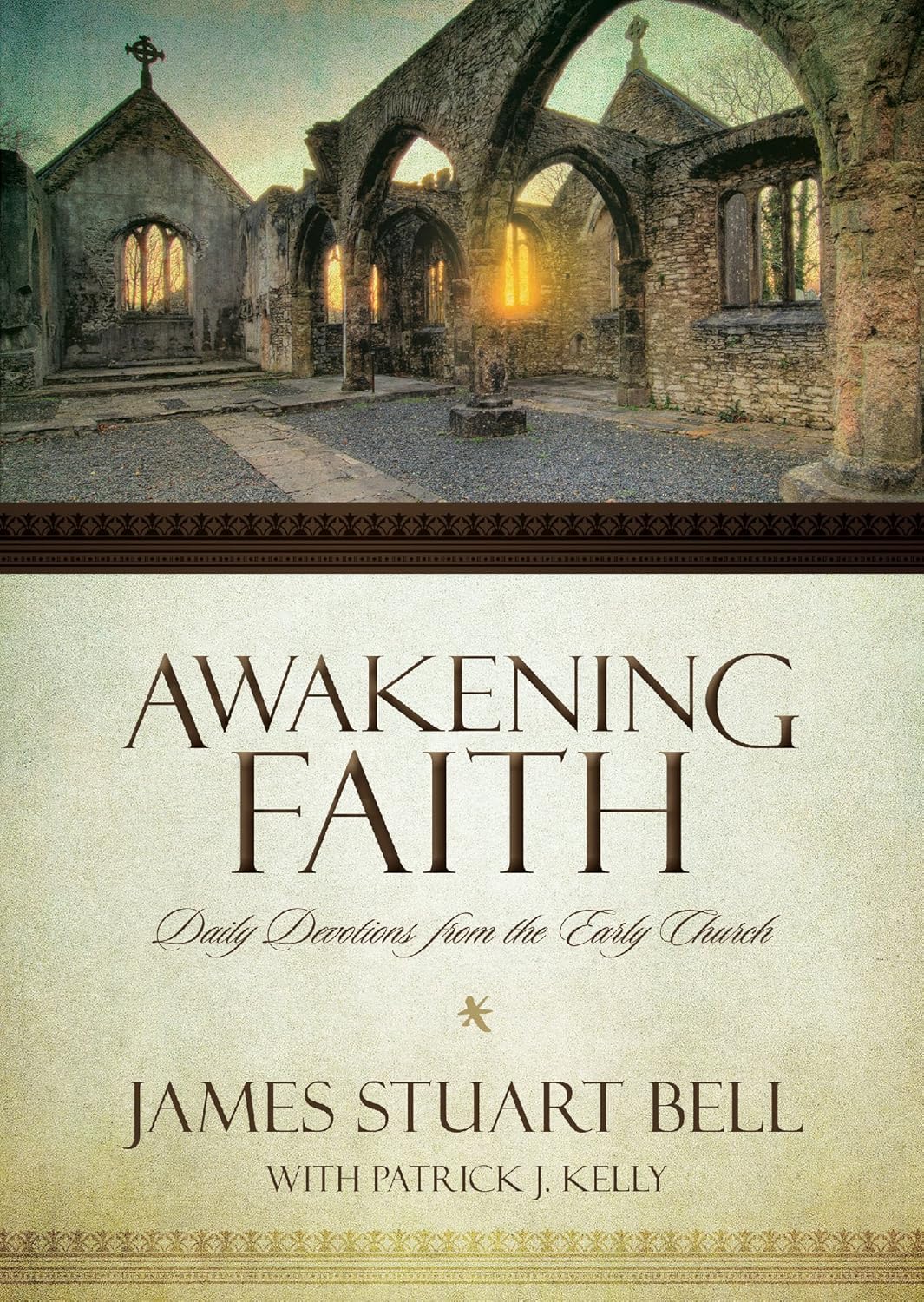
The genre of daily devotional reading is one with an overwhelming number of entries of varying quality, but in Awakening Faith: Daily Devotions from the Early Church, James Stuart Bell (with Patrick J. Kelly) provides a unique and edifying offering. As the title indicates, Bell has assembled 366 readings from the Early Church Fathers, discussing a variety of topics related to the Christian life. In addition to providing short daily expositions on the Scriptures, Awakening Faith serves to introduce readers to the writings of some of the earliest Christian thinkers and leaders.
Each daily entry begins with a Bible verse (or two), followed by a reading from a Church Father that either references/alludes or has a thematic connection to the Scriptural passage. The selections have been updated into modern language for improved readability. The selection of authors is diverse, ranging from the highly-esteemed, such as Athanasius and Augustine, to the unknown, such as Pseudo-Chrysostom and the author of The Letter to Diognetus. Some of the included authors, such as Origen and Commodianus, are known for having problematic teachings, but as Bell notes in his introduction, the selected readings were chosen to "showcase those things they emphasize that today's evangelicals do not, generally to our detriment." At the end, the book contains brief biographical notes for each of the included authors. Many of the book's readings focus on Christian virtues and personal holiness, often in the form of exhortation. Each passage is limited to a single page (though some extended passages are split over multiple days), which makes for a short but substantive read.
Overall, I found Awakening Faith to be a very useful devotional collection. In the introduction, Bell makes a brief but cogent argument for why modern evangelicals should make a point to familiarize themselves with the wisdom of Christians from eras past. For those with limited (or even non-existent) knowledge of the Church Fathers, this book would serve as a great point of introduction. And even for those with previous experience reading the Fathers, these readings are both encouraging and convicting. As Bell observes, these writers were committed to the Scriptures, and their works overflow with explanations and applications of the Bible. That grasp of Scripture, combined with the exhortation to piety and holiness, provides a model that modern readers would do well to emulate. I also appreciated how the Fathers had a completely different outlook than I do, and I often found myself stopping to ponder their words in ways I might not have if they were modern authors discussing similar topics.
I had no real complaints about the book, although a couple of improvements could be made. First, the book identifies only the author of each selection; it would have been helpful to include the specific work from which it was taken (even if relegated to an appendix). Although the selections are meant to stand alone, there were several times when I wished I could have looked up the surrounding context. Secondly, the heading for each page lists the topic addressed, such as "Holiness" or "The Church"; it would have been useful to have an index of all the topics and associated selections, as there was for readings by specific author. That said, neither of these omissions detract from the overall quality of the book.
In sum, if you are looking to pick up a book of daily devotional reading, are interested in learning more about the early Church, or both, Awakening Faith: Daily Devotions from the Early Church is highly recommended.
(Disclaimer: I received a free copy of this book in exchange for providing an unbiased review.)
Sunday, March 24, 2013
Book Review - Galatians For You

To be honest, I pity the authors who have to write subsequent volumes in the series, because Keller has set the bar pretty high. I was initially skeptical about the Read-Feed-Lead format, but the book weaves together the different purposes and audiences quite well. In less skillful hands, a book with such a wide intended audience could easily degenerate into an appeal to the lowest common denominator, but not so here. Even in writing for enquirers and new believers, it is apparent that Keller wants to encourage readers to stretch and grow in their knowledge of the text, and ultimately of the Lord who gave it. And his questions for reflection are hardly fluff, but are actually quite thoughtful and even convicting. An example picked at random: from the chapter on Galatians 2:1-10, "Both personally and as part of your church, do you tend to over-adapt or under-adapt the gospel for the culture around you?" My only caveat is that I'm not sure that Keller's book by itself is enough to handle to Lead aspect (i.e., leading a Bible Study on Galatians, or preaching through it), but there is a companion study guide that is tailored for small group study.
The book's greatest strength lies in the way that Keller clearly articulates and emphasizes the theme of the Gospel of grace throughout his treatment of the epistle. From the very start, Keller stresses the need for Christians to truly understand the grace of Christ and to never underestimate their need for it. In fact, in his second chapter he writes:
Grace is not only the means of gaining the salvation achieved by Christ's death and resurrection, it is also the means of living the Christian life. In discussing everything from the error of the Judaizers, to the work of the Spirit, to the role of the Law, to the profundity of the believer being adopted as a child of God, Keller ties it all back to the complete sufficiency of Christ's work and the utter folly of trying to improve upon. As Keller memorably puts it, "you can't add to Christ without subtracting Christ. He is either all [our] value or He is without value." Furthermore, Keller does a great job of translating the situation of Galatians, which revolves around discussions of potentially unfamiliar subjects such as circumcision and food laws, into terms more accessible to a modern audience, such as the threats posed by social/racial divisions in the church or the dangers of unflinching adherence to non-essential cultural and theological distinctives. On the latter, Keller does not hesitate to sound a word of caution for his own Reformed tribe, observing that championing justification by faith alone does not always protect against relying on good doctrine as a source of salvation. In Keller's treatment, Galatians is hardly relegated to the record of religious debate from millennia past; rather, it is supremely practical and relevant to readers in our own day (and all others).You might think: We covered this in Chapter One of this book! And we did - but this letter, in its structure as well as its content, shows us that the gospel of grace underpins every step of the Christian life. Paul will keep coming back to it; so should we, in our lives, our prayers, our thoughts, our preaching and teaching.
The few quibbles I had about the book did little to detract from its overall value. As mentioned above, despite its usefulness, I'm not sure it succeeds as a one-stop shop for preaching/teaching. Individuals seeking to lead a Bible Study or preach through Galatians would be advised to use Keller's book in conjunction with other resources. One other aspect of the book that nagged at me was the way that Keller glosses over Paul's references to people being cursed/condemned. To be fair, Keller makes it clear that Paul sees the right understanding of the Gospel as a matter of eternal life and death. But when discussing "the curse" or "condemnation", Keller devotes much more time to the subjective, present experience of his audience, such as the anxiety and insecurity of the person who constantly fails to live up to whatever standard of works-righteousness they have adopted. True as that is, I don't think Keller's emphasis on the subjective aspects of deviating from the Gospel do justice to Paul's concerns. In general, I'm not a fan of "turn or burn" type preaching and teaching, but given the sharp tone and language of Paul's letter to the Galatians, I wish Keller would have focused more on the big picture of what is truly at stake when the Gospel is corrupted. Nevertheless, this omission did not significantly interfere with my enjoyment of the book.
In summary, Galatians For You is highly recommended for anyone seeking to better understand Paul's epistle, whether as a new believer or as a lifelong student of the Scriptures. Although the book is not overly-long, Keller has packed enough insight and application between its covers to keep the thoughtful reader engaged for quite some time.
(Disclaimer: I received a free copy of the book in exchange for writing a review, though without any stipulations on its content.)
Friday, November 02, 2012
Book Review - Christ and the Desert Tabernacle
 The Introduction to J.V. Fesko's Christ and the Desert Tabernacle immediately resonated with me, as he described an all-too-familiar phenomenon: the attempt to read through the Bible in a year. More specifically, I resonated with how jarring it can be to transition from the narrative of Genesis and Exodus into the detailed, often tedious instructions for building the tabernacle. For many Christians, these chapters are alien and seemingly irrelevant to their faith and practice. Fesko's book is an attempt to help faithful readers see the significance of these chapters, not only for God's Old Testament people, but also for believers today. Though Fesko is a professor of theology at Westminster Seminary, California, he has written a very accessible book. As one blurb on the back cover states, "while the book is geared toward the average layperson, it is not simplistic, but profound." Having its origins in a sermon series on Exodus, the book conveys Fesko's pastoral concerns for Christians to understand and appreciate how the entire Bible works together to proclaim the Gospel of Jesus Christ.
The format of the book is pretty straight-forward: Fesko starts in Exodus 25 and works through the instructions given for the construction of the tabernacle. Each chapter focuses on a different section, such as the Building Materials, the Ark of the Covenant, the Table and Bread of the Presence, etc. For each section, Fesko begins by explaining the details given in the Exodus text, indicating the significance of particular items and possible symbolism (e.g., the requirement that a blue curtain be used to separate the most holy place from the rest of the tabernacle is meant to evoke the sky, and more specifically, the recurring motif of God's throne being in heaven). He then turns to the New Testament to interpret the tabernacle construction in light of the person and work of Christ (e.g., just as the Old Testament tabernacle represents God's presence among his people, John 1 uses that same word "tabernacle" to describe the incarnation of the Son of God, who took on flesh to dwell among his people). Finally, in each section, Fesko draws practical applications for Christian believers (e.g., the Israelites were to donate the building supplies for the tabernacle voluntarily, out of a generous heart -- their involvement in building the tabernacle was never described as repayment for God delivering them from Egypt. In the same way, Christians should respond to the grace we have received in Christ by giving generously to the building of his church, not out of obligation but from a desire to see the Gospel spread into all the world.) Having experience as both a professor and a pastor, Fesko is able to exegete the Old Testament text, interpret its theological significance in light of the New Testament, and then apply it to the Christian life in a very relevant and meaningful way.
The book is relatively short (133 pages), so it could be a quick read. But there's plenty to warrant pondering over. Each chapter strikes a good balance between content and application, and I could easily see it being used for small group Bible study, as well as devotional reading.
Overall, Christ and the Desert Tabernacle is recommended for anyone interested in learning not only about the Old Testament tabernacle, but also about how it fits into God's overall plan of redemption through Christ.
Friday, July 27, 2012
Book Review - A Theology of Luke and Acts
A Theology of Luke and Acts, by Darrell Bock, is the second installment (of eight planned) in Zondervan's Biblical Theology of the New Testament series. As the publisher's website states,
Chapter 3 presents "The Case for the Unity of Luke-Acts and Reading the Volumes as Luke-Acts and as Luke and Acts." As Bock states from the chapter's outset, "Before one can work with Luke and Acts and present their theology as a unified whole, one must make the case that these volumes were intended to be seen as a literary unit and can be read as such." Since Bock's work contains 17 chapters worth of discussion on various theological themes appearing in Luke and Acts, there's a good bit riding on his case that Luke and Acts present a unified theology!
The chapter begins with a bibliography of sources relevant to the discussion. One noteworthy feature is that Bock interacts with sources which were published predominantly within the last 5-10 years, in keeping with the BTNT's goal of providing a survey of recent scholarship. In Chapter 3, Bock presents the case that Luke and Acts were originally designed and written to tell one basic story. As various scholars have observed, the two books correspond at several important points, such as the similarities of their respective prologues, the description of Israel's tragic rejection of their Messiah, the portrayal of Jesus' interaction with the main characters of each book (i.e., Peter and Paul), and the emphasis on the Gentile mission (hinted at in Luke but coming to fruition in Acts) - not to mention structural details linking Luke 24 with Acts 1. The preponderance of these features strongly indicate that Luke and Acts should be read not merely as two books by the same author, but as a literary unity.
However, not all scholars have accepted this position, and Bock surveys the two major categories of objections: one, that certain tensions between the two books challenge a unified reading, and two, that the early church's use of the books (especially in the ordering of the canon) indicate that they were not viewed as a single unit. Bock treats these objections evenhandedly, but also responding to each point from additional relevant scholarship. To the first objection, Bock concludes that the sheer amount of similarities and connections between the two books far outweighs the purported tensions. As to the second objection, he argues that the early church's treatment of the books as separate ends up being a matter of nuance, and not a factor which undermines the literary unity of Luke-Acts. Ultimately, he allows for the value that can come from reading Luke and Acts as separate units on their own terms, but holds firm to the case that the two are best seen as a unified work. In the end, the suitability of the two different perspectives depends on the intended use: in terms of developing a biblical theology, Luke-Acts should be seen as a whole, whereas the church's canonical division between Luke and Acts serves as a reminder of the drastic new-ness of the faithful community created after the death and resurrection of Christ.
Having set the stage in Chapter 3 with this argument for the unity of Luke-Acts, Bock then spends the rest of the book surveying the text to discuss several theological themes, examples of which include the Person and Work of Jesus, the Holy Spirit, Israel, the Gentiles, Discipleship, Ethics, Ecclesiology, and Eschatology. In each chapter, he interacts with applicable scholarship, and provides plenty of bibliographical material for further study.
Overall, Bock succeeds in providing a useful overview of the major themes of Luke-Acts. The interaction with scholarly literature allows for a nuanced discussion, although Bock never intends his work to be a mere compendium of scholarship - that is, he presents his own assessment of the topic of hand. As expected in a book of this sort (and one whose primary object of study presents such a wide range of topics for discussion!), Bock often has to greatly summarize the positions with which he is dialoguing, but the detailed bibliography gives plenty of entry-points for these wishing to go deeper. Anyone seeking to study the theology of Luke-Acts would be well advised to consult A Theology of Luke and Acts by Darrell Bock.
(Disclaimer: the publisher provided me with a copy of the book in exchange for writing a review. I was and am under no obligation to provide a favorable review.)
The Biblical Theology of the New Testament (BTNT) series provides upper college and seminary-level textbooks for students of New Testament theology, interpretation, and exegesis. Pastors and discerning theology readers alike will also benefit from this series. Written at the highest level of academic excellence by recognized experts in the field, the BTNT series not only offers a comprehensive exploration of the theology of every book of the New Testament, including introductory issues and major themes, but also shows how each book relates to the broad picture of New Testament theology.Bock, having spent over three decades studying and writing about both Luke and Acts, is certainly qualified for the task, and his volume is a suitable contribution to the BTNT series. A closer examination of a representative chapter demonstrates both the overall format and the intended goals of the book and series.
Chapter 3 presents "The Case for the Unity of Luke-Acts and Reading the Volumes as Luke-Acts and as Luke and Acts." As Bock states from the chapter's outset, "Before one can work with Luke and Acts and present their theology as a unified whole, one must make the case that these volumes were intended to be seen as a literary unit and can be read as such." Since Bock's work contains 17 chapters worth of discussion on various theological themes appearing in Luke and Acts, there's a good bit riding on his case that Luke and Acts present a unified theology!
The chapter begins with a bibliography of sources relevant to the discussion. One noteworthy feature is that Bock interacts with sources which were published predominantly within the last 5-10 years, in keeping with the BTNT's goal of providing a survey of recent scholarship. In Chapter 3, Bock presents the case that Luke and Acts were originally designed and written to tell one basic story. As various scholars have observed, the two books correspond at several important points, such as the similarities of their respective prologues, the description of Israel's tragic rejection of their Messiah, the portrayal of Jesus' interaction with the main characters of each book (i.e., Peter and Paul), and the emphasis on the Gentile mission (hinted at in Luke but coming to fruition in Acts) - not to mention structural details linking Luke 24 with Acts 1. The preponderance of these features strongly indicate that Luke and Acts should be read not merely as two books by the same author, but as a literary unity.
However, not all scholars have accepted this position, and Bock surveys the two major categories of objections: one, that certain tensions between the two books challenge a unified reading, and two, that the early church's use of the books (especially in the ordering of the canon) indicate that they were not viewed as a single unit. Bock treats these objections evenhandedly, but also responding to each point from additional relevant scholarship. To the first objection, Bock concludes that the sheer amount of similarities and connections between the two books far outweighs the purported tensions. As to the second objection, he argues that the early church's treatment of the books as separate ends up being a matter of nuance, and not a factor which undermines the literary unity of Luke-Acts. Ultimately, he allows for the value that can come from reading Luke and Acts as separate units on their own terms, but holds firm to the case that the two are best seen as a unified work. In the end, the suitability of the two different perspectives depends on the intended use: in terms of developing a biblical theology, Luke-Acts should be seen as a whole, whereas the church's canonical division between Luke and Acts serves as a reminder of the drastic new-ness of the faithful community created after the death and resurrection of Christ.
Having set the stage in Chapter 3 with this argument for the unity of Luke-Acts, Bock then spends the rest of the book surveying the text to discuss several theological themes, examples of which include the Person and Work of Jesus, the Holy Spirit, Israel, the Gentiles, Discipleship, Ethics, Ecclesiology, and Eschatology. In each chapter, he interacts with applicable scholarship, and provides plenty of bibliographical material for further study.
Overall, Bock succeeds in providing a useful overview of the major themes of Luke-Acts. The interaction with scholarly literature allows for a nuanced discussion, although Bock never intends his work to be a mere compendium of scholarship - that is, he presents his own assessment of the topic of hand. As expected in a book of this sort (and one whose primary object of study presents such a wide range of topics for discussion!), Bock often has to greatly summarize the positions with which he is dialoguing, but the detailed bibliography gives plenty of entry-points for these wishing to go deeper. Anyone seeking to study the theology of Luke-Acts would be well advised to consult A Theology of Luke and Acts by Darrell Bock.
(Disclaimer: the publisher provided me with a copy of the book in exchange for writing a review. I was and am under no obligation to provide a favorable review.)
Friday, December 30, 2011
Book Review - Children and the Lord's Supper

Children and the Lord's Supper is a collection of essays addressing the issue of (as you can probably guess) children's participation in the Lord's Supper. Specifically, the book provides a critical assessment of the doctrine of paedocommunion, defined as "the admittance of a covenant child to the Lord's Supper on the basis of his descent from at least one professing Christian parent." Edited by Guy Waters and Ligon Duncan, Children and the Lord's Supper offers both a rebuttal to pro-paedocommunion arguments as well as a defense of the historic Reformed position that covenant children should be admitted to the Lord's Table only after providing a credible profession of faith. The collected essays address the topic from Biblical, theological, historical and pastoral standpoints.
The book is released under the Mentor imprint of Christian Focus Publications, indicating that its intended audience includes pastors, seminary students, and other serious readers. The book would also be most appropriate for those examining the issues from within the Presbyterian and Reformed traditions, as the historic Reformed confessions form a starting point for much of the book's arguments. The book's contributors include a number of respected Reformed authors, including Derek Thomas, Joel Beeke and Cornelis Venema (in addition to Waters and Duncan). The collected essays address topics including the nature of the link between the Lord's Supper and the Passover, the application of the critical "self-examination" passage in 1 Corinthians 11, an examination of relevant portions of the Reformed Confessions and liturgies, and a survey of historical evidence for the practice of paedocommunion in the Patristic era.
I would recommend Children and the Lord's Supper to anyone looking for a succinct defense of the traditional Reformed view on admission of children to the Lord's Supper. Those outside the Reformed tradition will also benefit from reading the book, particularly the essays on the Passover, 1 Corinthians 11, and the history of the practice in the early church. For non-Reformed readers, the essays dealing largely with the confessions and Reformed liturgy may be interesting but not as helpful in evaluating the practice of paedocommunion. (Admittedly, I have not read much in the way of pro-paedocommunion literature, especially the works critiqued in this collection, so I will have to defer to others to indicate whether the pro side has been fairly represented.)
Personally, the issue of children and the Supper is one I have not firmly settled in my own mind, and instead of settling the matter, Children and the Lord's Supper gave me further food for thought. I am a member of a Presbyterian church, so I do hold the Reformed confessions in high esteem. Yet they aren't infallible, so I would have appreciated if the book had spent more time examining the relevant Biblical texts than it did. I also found the historical survey most interesting, as it pointed to a diversity of practice in the early church. Perhaps this points toward a way forward on the issue of children and communion? Either way, the book provides a great starting point to a conversation on an important topic, and I look forward to hearing the other side present their case.
(Disclaimer: I received a free copy of the book in exchange for writing a review. I was under no compulsion to provide a positive review.)
Monday, February 01, 2010
Product Review: Puj Baby Bathtub
When I was pregnant with our second son, I got into all these cool baby items that were coming out on the market, one of which is the PUJ baby bathtub.

Last fall, I signed up to be a product tester and wouldn't you know, the tub arrived in the mail right before we moved. So, this review is a little late in coming. But better late than never, right?
I've liked the look of this bathtub since I first heard about it in 2008. Back then, though, it was way more expensive ($99) and didn't seem to be a necessity since we already had a clunky blue plastic bathtub that worked fine. Well, I might've been mistaken. The PUJ is one of the most unique baby bath tubs I've ever seen and would be a great addition to any new mom's wishlist.
Since my two boys are too big for this (can be used up to 6 months), I tried it out with a doll and also had another friend try it out with her baby.
Pros:
The Puj tub stores easily. It arrived in a large, lightweight, flat box, and is only about an inch thick. You can hang it on the back of a door, like I did here, or you could slide it in a linen closet or even hang it on the wall of the shower.

The Puj tub is easy to maneuver -- no assembly required. Once I figured out which way the flaps folded, it stayed securely in place with magnets (which are safely covered). The design is deceptively simple.
The Puj tub cleans quickly and effortlessly. I wiped mine down after use and let it hang to dry. There is no drain plug to get clogged or dirty and no place for standing water to collect.
The Puj tub let me wash an infant securely. When using the tub, I felt like the baby was safer than in the infant tub/sling I used when my sons were newborns, because in the Puj there was no danger of them being covered by water. Also, it fits nicely in our bathroom sink and doesn't slide out or tilt at odd angles like my other tub did.

Cons:
You can't use it with babies who are older than six months. Seriously! I liked it that much! I suppose at that point babies are too big and wiggly anyway and want to sit up, but it sure would be nice if I could just plop my toddler in something like this!
The only drawback I noticed is with an older baby who likes to grab things, the close proximity of the faucet might be a distraction.
The tub might not fit every sink or be right for every baby. In my friend's review, she thought that, "Overall, it is a very cool idea, but didn't work out well for my baby. He enjoys bath time when he's immersed in the warm water, but the Pujtub wasn't big enough to immerse him - so we'll have to stick to our bulky plastic bathtub." I hadn't thought of that perspective before, so perhaps that is another drawback.
Still, I think the benefits of being able to quickly and safely wash a newborn in a tub that fits almost every sink would've been great for all the travelling we did when our boys were little. The Puj tub packs light, dries quickly and easily, and seems to be a unique invention. They are now only $39.99.
Check out the Puj Tub for yourself at Puj's exclusive new website for baby bath tubs!
Giving Back:
Though this is not a reason to buy the tub, I did notice that right now 10% of their sales are going Save the Children in Haiti.
|

Last fall, I signed up to be a product tester and wouldn't you know, the tub arrived in the mail right before we moved. So, this review is a little late in coming. But better late than never, right?
I've liked the look of this bathtub since I first heard about it in 2008. Back then, though, it was way more expensive ($99) and didn't seem to be a necessity since we already had a clunky blue plastic bathtub that worked fine. Well, I might've been mistaken. The PUJ is one of the most unique baby bath tubs I've ever seen and would be a great addition to any new mom's wishlist.
Since my two boys are too big for this (can be used up to 6 months), I tried it out with a doll and also had another friend try it out with her baby.
Pros:


Cons:
Still, I think the benefits of being able to quickly and safely wash a newborn in a tub that fits almost every sink would've been great for all the travelling we did when our boys were little. The Puj tub packs light, dries quickly and easily, and seems to be a unique invention. They are now only $39.99.
Check out the Puj Tub for yourself at Puj's exclusive new website for baby bath tubs!
Giving Back:
Though this is not a reason to buy the tub, I did notice that right now 10% of their sales are going Save the Children in Haiti.
|
Monday, November 10, 2008
Book Review -- A Primer on Worship and Reformation

(The following review refers to a pre-publication galley copy, which the fine folks at Canon Press were kind enough to send me.)
Releasing this week is Douglas Wilson's latest, A Primer on Worship and Reformation: Recovering the High Church Puritan. As the title would indicate, the book is a short overview on how the right worship of God is vital to rescuing wayward American Christianity.
The first chapter, "They'll Know We Are Christians By Our Schlock," laments the state of American Christianity, which is far too often driven by cash registers than by the Word of God. Wilson applies his usual "serrated edge" to provide a brief inventory of relics, a list of the wackiness that often passes for expressions of Christian devotion. But instead of dwelling on Testamints and praise song hand motions, he proceeds to sketch out the cultural trends that have brought us to this place, such as rugged individualism and pietism. By doing so, he highlights the false dilemma accepted by those seeking to address such issues in the church: endure heresy or embrace schism. However, there is a third way: namely, that of reformation.
To advance this alternate approach, Wilson adopts the term "High Church Puritan." As he explains, he uses "Puritan" in its original sense: "one who has a deep desire to purify the Church, but who has no intention of voluntarily separating from that Church if he doesn't get his way immediately." Hence the qualifier "High Church," which signals a serious understanding of the covenant and the bond it creates between Christians -- even those in error. For those dismayed by the frivolities and idolatries of modern evangelicalism, neither doctrinal apathy nor schism are viable options. Rather, the task at hand is to work within the church to reform it. As always, reformation in the church -- and in ourselves -- begins and ends with Scripture.
As Wilson argues, true evangelism is much more than simply exhorting individual believers to share the Gospel with those around them. Rather, evangelism is the work of the Church, which seeks to transform the culture by first being transformed herself by the right worship of God. To encourage reformation of our worship, Wilson devotes chapters to each of the following:
- Covenant renewal worship -- as summarized in Jeff Myers' pattern of call, confession, consecration, communion and commissioning;
- Thundering the word -- for modernist methods of interpretation cannot be allowed to trump what Scripture teaches about itself;
- The Lord's Supper -- which is an indispensable source of spiritual life;
- Recovery of the Psalms in worship -- because God has given them for our use and benefit;
- Right understanding of the Sabbath -- for the Lord's Day is not a drab observance of rules, but rather a joyful time of resting and feasting; and
- The place of children in church -- because the blessings of the covenant are for them, and they should be nurtured in the faith instead of taught to doubt.
I've read quite a few books on worship, but I really enjoyed this one. Wilson does not try to prescribe a one-size-fits-all approach to worship, and he freely admits that worship can look different from church to church without sacrificing its integrity. Instead of focusing on the nuts and bolts, he looks at the larger picture of the concerns and values that churches should bring to their worship. Plus, instead of simply berating Christians who worship in a trivial (or even blasphemous) manner, Wilson sees them as brothers and sisters in need of loving correction. Although brief, A Primer on Worship and Reformation packs in quite a bit of great material, all of which is useful for establishing a foundation for the right worship of God. I'd recommend this book to anyone interested in Christian worship, whether they spend Sunday mornings in the pulpit, the choir or the pew.
(Note: the official release date is November 11, but Canon Press is offering free shipping on all orders placed prior to this date.)
|
Thursday, July 17, 2008
Dutch: A Review
 Dutch: A Memoir of Ronald Reagan by Edmund Morris
I was only 8 years old when Ronald Reagan left office, so I felt like I was rediscovering the famed era of my childhood while reading this book. RR was such an imposing figure upon my imagination, and I remember sadly watching as Alzheimer's slowly took his faculties and he dwindled away into a shadow of what he once was, while I grew into an adult. Through this biography, I learned much about the inner-workings of twentieth-century American history, and especially about Dutch himself. Though the author clearly displays Reagan's failings as well as his successes, I came away with a sense of awe and respect for this magnanimous man who denouced the "evil empire" and dreamed of a defense system in the stars.
The best part about this memoir is the author's ability to insert himself into the narrative (which was highly controversial, since Morris basically made himself a semi-fictional character in Reagan's story), but here, it works. This is a much more literary biography than I've read before, with beautiful, haunting descriptions and creative narrative touches throughout, including (appropriately enough for an actor-turned-President), a smattering of movie script-style sections.
The only drawback, in my opinion, is that I think the author expects the reader to be more familiar with the time period that is covered; there were many cultural and historical allusions or references that were unfamiliar to me. Perhaps, though, it just means I need to brush up on my 20th Century history!
All in all, I rate this as a fantastic book, and well worth the six months it took me to finally finish (of course, I had to read the footnotes, too-- they are almost as interesting as the bio itself!). Highly recommended to all, epseically during this Presidential election year. I think I began reading this the night after the Republican primary at the Reagan library. Hopefully, you will be able to finish it much sooner than I did, though it is a whopping 841 pages!
|
Monday, March 17, 2008
On the Edge of the Dark Sea of Darkness Book Review
Any book with the subtitle "Adventure. Peril. Lost jewels. And the Fearsome Toothy Cows of Skree." will be sure to get my attention. Upon opening said book, I would expect to find action, mystery, suspense...and a large helping of humor. I was not disappointed!
In his first novel, On the Edge of the Dark Sea of Darkness, Andrew Peterson weaves a magnificent tapestry out of what is at first glance merely an enjoyable children's fantasy story. Peterson has transmogrified* the ordinary adventure into a rollicking, robust tale that is neither too silly nor too sad nor too syrupy sweet, yet has the proper doses of all of the above. From beginning to end, this first installment of the Wingfeather Saga resounds with hope, stirs the heart, and tickles the funny bone while offering glimpses of the One True Story that makes all others worthwhile.
 This imaginary world is imbued with a gaggle of cartoonish, oddly familiar creatures: some good, some benign, and some dangerous. The good, a family called Igiby, are our protagonists, and these three ordinary children will soon be caught up in an extraordinary adventure that begins in their own small township. When Tink, the middle brother, finds a mysterious map which mentions the lost jewels of Anniera, the siblings are propelled into a series of events that will forever alter their ordinary, somewhat comfortable lives, (since it is hard to be comfortable when you have been ruled by Gnag the Nameless for nine long years). With help from their mother Nia, grandfather Podo and various friends, the Igiby children attempt to avoid the dangerous Fangs--and horned hounds, toothy cows, and the occasional traitor in disquise--who are determined to harm them and capture the lost jewels for their leader.
Something that surprised me about this story was Andrew's ability to make even the most hilarious-sounding characters come to life with a pathos and drama that runs deeper than your usual children's book. From the Igiby three to Peet the Sock Man and Zouzab the Ridgerunner, Peterson has managed to develop amazingly complex, robust characters despite silly-sounding names. I did not expect to get so caught up in the Igiby's world, but by the end of the book, Peterson's ability to bring his characters to life forged an emotional connection, and I just couldn't put the book down. Though I guessed correctly about some of the events and circumstances, I was enthralled with these children and their world and stayed up past my bedtime, like a kid with a flashlight under the covers enjoying every stolen moment.
Not only has Peterson created a thrilling story, he also has perfect comedic timing coupled with a unique and somewhat odd, yet appealing, narrative style. Just a few chapters in, I was almost overcome by the giggle-inspiring vocabulary. The trilling titles of Leeli Igiby and Oskar N. Reteep, quotations from notables Eezak Fincher and Bip Thwainbly and locations like Fingap Falls and the Glipper Trail beg to be read aloud. From descriptions of Zizby matches on the lawn to a garden full of totatoes and a forest filled with cave blats, I had to keep pronouncing the not-quite-familiar words to myself so I wouldn't get confused. (By the way, AP, if you read this, I'm still not sure how to pronouce "Anneira". A-near-ra? An-ne-eye-ra? In my head it's stuck as A-near-re-a, for some reason.) Also, dear reader, you must be prepared for the footnotes. "Footnotes?" you might ask. "In a kid's book?" Somehow, Andrew makes it work. The result is only slightly jarring, as he will intersperse the most tense and serious moments with a random aside, but it helps to break the creschendo of action and offers a chance for the reader to make mock-serious Masterpiece Theater voices.
(The only thing better than reading this book aloud with your family would be to watch a live performance of Andrew Peterson voicing all the characters. You know that Aeden, Jesse, and Skye must have so much fun listening to their Papa tell bedtime stories!)
Peterson has thoughtfully imagined not only the names of characters and places, but also his entire mythical world. I admit, by the end, Peterson impressed me with the cohesion of his narrative. As one who wrote a senior thesis on C.S. Lewis' Narnia Chronicles, after finishing this first edition of the Wingfeather Saga, I will tentatively predict that Andrew has created a more comprehensive world than Lewis did. (Narnia fans, don't skewer me, please! Hear me out!) While Lewis borrowed his creatures from Norse, Greek, and Roman mythology as well as from his friend J.R.R. Tolkien, Peterson created his inhabitants (almost) entirely from scratch, providing extensive (and hilarious) footnotes on their backstories and providing humorous details that may or may not be relevant but are always entertaining. Admittedly, there are traces of Tolkien and Lewis and even J.K. Rowling (garden gnomes = thwaps) throughout, which is not surprising since they are some of his favorite authors. Peterson, however, breathes new life into an oft-imitated genre, with a unique voice and an enduring theme. I won't go so far as to say that the Igibys are the next Harry Potter, since that may be an impossible feat in the publishing world these days, but these books are sure to instill a love of reading into at least a few hundred dozen kids, one of whom I hope is my own.
As a fan of Andrew Peterson's music for almost ten years now, I would be remiss if I didn't mention some of his songs and lines that this book brought to my mind. The obvious "Little Boy Heart Alive" is overshadowed, in my opinion, by these fitting lines from a song Peterson wrote with Andrew Osenga, titled "More":
When I read the last sentence of On the Edge of the Dark Sea of Darkness, I felt at once that Peterson's book rang true. The hope that was shining in the Igiby home reflects the Hope that shines throughout Peterson's music and his life. I am grateful that through this book he has shared with us some of the light and laughter that fills his home.
Andrew Peterson is a critically acclaimed singer-songwriter and recording artist best known for his Dove Award-winning songs of the year, “Nothing to Say” and “Family Man.” A natural-born storyteller (being a preacher’s kid from the south), he wrote and produced the popular Christmas play and musical, Behold the Lamb of God. He has recorded seven albums and tours every year. Andrew and his wife, Jamie, are the parents of two sons and a daughter and live in Nashville, Tennessee. His website is www.andrew-peterson.com.
I hope this review inspired you to pick up a copy for yourself! You can buy it at Amazon or directly from Peterson himself at The Rabbit Room. We do have one extra copy you can win for yourself, so stay tuned for the Giveaway Announcement coming soon!
*transmogrify (v): to change or alter greatly and often with grotesque or humorous effect.
|
In his first novel, On the Edge of the Dark Sea of Darkness, Andrew Peterson weaves a magnificent tapestry out of what is at first glance merely an enjoyable children's fantasy story. Peterson has transmogrified* the ordinary adventure into a rollicking, robust tale that is neither too silly nor too sad nor too syrupy sweet, yet has the proper doses of all of the above. From beginning to end, this first installment of the Wingfeather Saga resounds with hope, stirs the heart, and tickles the funny bone while offering glimpses of the One True Story that makes all others worthwhile.
 This imaginary world is imbued with a gaggle of cartoonish, oddly familiar creatures: some good, some benign, and some dangerous. The good, a family called Igiby, are our protagonists, and these three ordinary children will soon be caught up in an extraordinary adventure that begins in their own small township. When Tink, the middle brother, finds a mysterious map which mentions the lost jewels of Anniera, the siblings are propelled into a series of events that will forever alter their ordinary, somewhat comfortable lives, (since it is hard to be comfortable when you have been ruled by Gnag the Nameless for nine long years). With help from their mother Nia, grandfather Podo and various friends, the Igiby children attempt to avoid the dangerous Fangs--and horned hounds, toothy cows, and the occasional traitor in disquise--who are determined to harm them and capture the lost jewels for their leader.
Something that surprised me about this story was Andrew's ability to make even the most hilarious-sounding characters come to life with a pathos and drama that runs deeper than your usual children's book. From the Igiby three to Peet the Sock Man and Zouzab the Ridgerunner, Peterson has managed to develop amazingly complex, robust characters despite silly-sounding names. I did not expect to get so caught up in the Igiby's world, but by the end of the book, Peterson's ability to bring his characters to life forged an emotional connection, and I just couldn't put the book down. Though I guessed correctly about some of the events and circumstances, I was enthralled with these children and their world and stayed up past my bedtime, like a kid with a flashlight under the covers enjoying every stolen moment.
Not only has Peterson created a thrilling story, he also has perfect comedic timing coupled with a unique and somewhat odd, yet appealing, narrative style. Just a few chapters in, I was almost overcome by the giggle-inspiring vocabulary. The trilling titles of Leeli Igiby and Oskar N. Reteep, quotations from notables Eezak Fincher and Bip Thwainbly and locations like Fingap Falls and the Glipper Trail beg to be read aloud. From descriptions of Zizby matches on the lawn to a garden full of totatoes and a forest filled with cave blats, I had to keep pronouncing the not-quite-familiar words to myself so I wouldn't get confused. (By the way, AP, if you read this, I'm still not sure how to pronouce "Anneira". A-near-ra? An-ne-eye-ra? In my head it's stuck as A-near-re-a, for some reason.) Also, dear reader, you must be prepared for the footnotes. "Footnotes?" you might ask. "In a kid's book?" Somehow, Andrew makes it work. The result is only slightly jarring, as he will intersperse the most tense and serious moments with a random aside, but it helps to break the creschendo of action and offers a chance for the reader to make mock-serious Masterpiece Theater voices.
(The only thing better than reading this book aloud with your family would be to watch a live performance of Andrew Peterson voicing all the characters. You know that Aeden, Jesse, and Skye must have so much fun listening to their Papa tell bedtime stories!)
Peterson has thoughtfully imagined not only the names of characters and places, but also his entire mythical world. I admit, by the end, Peterson impressed me with the cohesion of his narrative. As one who wrote a senior thesis on C.S. Lewis' Narnia Chronicles, after finishing this first edition of the Wingfeather Saga, I will tentatively predict that Andrew has created a more comprehensive world than Lewis did. (Narnia fans, don't skewer me, please! Hear me out!) While Lewis borrowed his creatures from Norse, Greek, and Roman mythology as well as from his friend J.R.R. Tolkien, Peterson created his inhabitants (almost) entirely from scratch, providing extensive (and hilarious) footnotes on their backstories and providing humorous details that may or may not be relevant but are always entertaining. Admittedly, there are traces of Tolkien and Lewis and even J.K. Rowling (garden gnomes = thwaps) throughout, which is not surprising since they are some of his favorite authors. Peterson, however, breathes new life into an oft-imitated genre, with a unique voice and an enduring theme. I won't go so far as to say that the Igibys are the next Harry Potter, since that may be an impossible feat in the publishing world these days, but these books are sure to instill a love of reading into at least a few hundred dozen kids, one of whom I hope is my own.
As a fan of Andrew Peterson's music for almost ten years now, I would be remiss if I didn't mention some of his songs and lines that this book brought to my mind. The obvious "Little Boy Heart Alive" is overshadowed, in my opinion, by these fitting lines from a song Peterson wrote with Andrew Osenga, titled "More":
A thing resounds when it rings true
Ringing all the bells inside of you
Like a golden sky on a summer eve
Your heart is tugging at your sleeve
And you cannot say why
There must be more
When I read the last sentence of On the Edge of the Dark Sea of Darkness, I felt at once that Peterson's book rang true. The hope that was shining in the Igiby home reflects the Hope that shines throughout Peterson's music and his life. I am grateful that through this book he has shared with us some of the light and laughter that fills his home.
Andrew Peterson is a critically acclaimed singer-songwriter and recording artist best known for his Dove Award-winning songs of the year, “Nothing to Say” and “Family Man.” A natural-born storyteller (being a preacher’s kid from the south), he wrote and produced the popular Christmas play and musical, Behold the Lamb of God. He has recorded seven albums and tours every year. Andrew and his wife, Jamie, are the parents of two sons and a daughter and live in Nashville, Tennessee. His website is www.andrew-peterson.com.
I hope this review inspired you to pick up a copy for yourself! You can buy it at Amazon or directly from Peterson himself at The Rabbit Room. We do have one extra copy you can win for yourself, so stay tuned for the Giveaway Announcement coming soon!
*transmogrify (v): to change or alter greatly and often with grotesque or humorous effect.
|
Tuesday, February 26, 2008
Nana's Covers
Are you looking for a practical and stylish way to keep your baby away from the nasty germs on shopping carts? Look no further than Nana's Covers.
About six weeks ago I was in a large Baby store looking for a shopping cart cover. Our son had recently acquired the disgusting habit of putting his mouth on the shopping cart whenever we went to buy groceries, and I wanted something to keep all those icky germs away. I had a small cover I had bought somewhere, but it didn't fit over large shopping carts and was cumbersome to put together. I asked a fellow shopper if she knew where the shopping cart covers were located in the store and she mentioned that her mother actually makes and sells them!
So, only a short while later, a glorious package arrived in the mail from Nancy at Nana's Covers. I had e-mailed her about some custom fabric that I liked, and here is the fantastic result (taken a few minutes after the mailman dropped it off). You can see Jacob was enjoying it already!

Nancy worked on this with great care and attention to detail: the stitching is strong and the navy accent fabric works wonderfully with the Blue Zoo pattern. There are pockets for a cell phone or wallet, a sippy cup holder, and a toy loop. Nancy also included cute matching toy rings on the toy loops, so we could start adding toys right away. She even created a matching patterned fabric drawstring bag (per my special request) to keep the cover clean while it is stored in the car! In the picture below, you can see the matching beads she added on the drawstring as well as a close-up of the Alexander Henry Blue Zoo fabric.

In the few weeks this has been in our posession, we have used this shopping cart cover everywhere: at the grocery store, on restaurant high chairs, and even at our local warehouse store -- it completely covered the extra-large seat! It is also machine washable, which is a bonus with a messy eater. I just hung it up to dry and it looks like new!

I cannot more highly recommend Nana's Covers and Nancy's craftmanship. The quality is much better than anything mass-produced, and of course I always prefer things that are handmade. To top it off, her prices are extremely reasonable, especially compared to some other handmade covers I found on the internet. So, if you are in the market for a shopping cart cover for your little one, please check out Nana's Covers. She has a variety of fabric choices available on her website, but will also be happy to accomodate any custom fabric you desire. She also sells blankets and clothing, so be sure to check out her site!
|
About six weeks ago I was in a large Baby store looking for a shopping cart cover. Our son had recently acquired the disgusting habit of putting his mouth on the shopping cart whenever we went to buy groceries, and I wanted something to keep all those icky germs away. I had a small cover I had bought somewhere, but it didn't fit over large shopping carts and was cumbersome to put together. I asked a fellow shopper if she knew where the shopping cart covers were located in the store and she mentioned that her mother actually makes and sells them!
So, only a short while later, a glorious package arrived in the mail from Nancy at Nana's Covers. I had e-mailed her about some custom fabric that I liked, and here is the fantastic result (taken a few minutes after the mailman dropped it off). You can see Jacob was enjoying it already!

Nancy worked on this with great care and attention to detail: the stitching is strong and the navy accent fabric works wonderfully with the Blue Zoo pattern. There are pockets for a cell phone or wallet, a sippy cup holder, and a toy loop. Nancy also included cute matching toy rings on the toy loops, so we could start adding toys right away. She even created a matching patterned fabric drawstring bag (per my special request) to keep the cover clean while it is stored in the car! In the picture below, you can see the matching beads she added on the drawstring as well as a close-up of the Alexander Henry Blue Zoo fabric.

In the few weeks this has been in our posession, we have used this shopping cart cover everywhere: at the grocery store, on restaurant high chairs, and even at our local warehouse store -- it completely covered the extra-large seat! It is also machine washable, which is a bonus with a messy eater. I just hung it up to dry and it looks like new!
I cannot more highly recommend Nana's Covers and Nancy's craftmanship. The quality is much better than anything mass-produced, and of course I always prefer things that are handmade. To top it off, her prices are extremely reasonable, especially compared to some other handmade covers I found on the internet. So, if you are in the market for a shopping cart cover for your little one, please check out Nana's Covers. She has a variety of fabric choices available on her website, but will also be happy to accomodate any custom fabric you desire. She also sells blankets and clothing, so be sure to check out her site!
|
Subscribe to:
Posts (Atom)